The Piazzale Michelangelo is surely one of the most beautiful places to visit in Florence Italy. Placed high on a green hillside overlooking the city, visitors can enjoy a breathtaking view of the whole city: you can spot the duomo, Palazzo Vecchio with its tower, Giotto’s bell-tower, the Arno river that flows and tear the city in two parts, with its bridges in sequence. Then turn around and look at the green hills around you, with classic and elegant Tuscany villas and the remaining ancient walls of Florence.
Piazzale Michelangelo was built in 1869 and designed by architect Giuseppe Poggi, when Florence became the capital city of Italy (for a short period) and needed big, magnificent public spaces to represent the power of the newborn Reign of Italy. A replica of Michelangelo's Statue of David stands in the centre of the plaza.
San Miniato al Monte
Near Piazzale Michelangelo there’s a wonderful Romanesque church, San Miniato al Monte, that’s so beautiful that lots of people from all over the world come here to get married. Beside the church there’s a monumental cemetery, and it’s surrounded with a nice small cypress forest where is such a pleasure to take a walk!
the wedding of a japanese couple in San Miniato al Monte
the monumental cemetery of San Miniato al Monte
You can reach Piazzale Michelangelo from the historical center with bus, number 12 or 13, it’s about a 15 minutes ride.
The construction of the Duomo, the Cathedral also called Santa Maria del Fiore, was started by Arnolfo di Cambio on the 8th September 1296. It is the fourth longest church in the world (after Saint Peter in Rome, Saint Paul in London and the Cathedral in Milan). In some experts' opinion, Arnolfo's project was quite different from the present building, but the outside walls undoubtedly are the same as those in the original plan. When Arnolfo died in 1310, there was a delay in the works. They however were started again in 1331, when the Guild of Wool Merchants took over the construction of the church. In 1334 Giotto was appointed ‘master’ of the works. He mainly attended to the building of the campanile (bell tower) and died three years later. There were several interruptions until 1367, when a competition was held and a final model for the church by four architects and four painters was accepted. The vault of the nave was finished in 1378 and the aisles were completed in 1380. Between this year and 1421 the tribunes and probably the drum of the dome were built. The octagonal dome, consisting of two concentric shells linked together, was completed in 1434. A competition was held for the dome in 1418 and, after many doubts, Filippo Brunelleschi's project was accepted in 1420. The church, dedicated to Santa Maria del Fiore (fiore referring to Florence) was consecrated on the 25 of March, 1436. The remarkable differences in the various parts of the Cathedral show the evident changes in taste during the long time passed between the foundation of the church and its completion. Outside the shape of the round blind arches is a Romanesque vestige. The whole interior, with its huge arches, doors and windows, is Gothic . The dome is a masterpiece of the Renaissance. The façade, though in Gothic style, is from the 19th century. On the north side of the Cathedral, the Porta della Mandorla, dating from the 15th century, shows a Gothic influence both in the architectural design and decoration.
The interior, in the shape of Latin cross, consists of a nave and two aisles. Massive pillars with composite capitals support the Gothic groined vaults. The frescoes on the north aisle, representing two 'condottieri' on horseback, are by Paolo Uccello and by Andrea del Castagno. In the lunettes above the entrances to the two sacristies there are terracotta works by Luca della Robbia. The design of the round stained glass window is by Lorenzo Ghiberti.
I took these pictures of Florence Cathedral (Santa Maria del Fiore) in a bright fresh morning of June 2008, just after a thick but quick rain, the air was clean and the sky was so bright... the big red silhouette of the dome was making a perfect contrast with the blue of the sky.
I always think that Filippo Brunelleschi did a great job building this dome!
The gallery is second only to the Uffizi in importance, and is notable for the works of Rubens, Pietro da Cortona, Tiziano e Raffaello (Titian and Raphael).
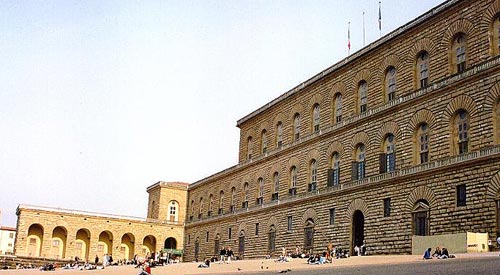
Begun in 1458 from an original design by Brunelleschi, the architecture was inspired by ancient Roman buildings. An enormous affair, it was built for Luca Pitti, a one time friend of the Medici who became jealous of their power and turned against them. The palace was a blatant attempt at one-upmanship, but the fortunes of the Pitti family soon faded, and the powerful Medici family acquired the building, still uncompleted, in 1540.
It was to become the family seat in Florence and it was Cosimo´s wife, Eleanor of Toledo (whose dowry paid for the purchase), who was to transform the hillside behind the palace into the Boboli garden.
Palazzo Pitti remained the principal Medici residence until the last male Medici heir died in 1737: the Medici dynasty became extinct and the palace passed to the new Grand Dukes of Tuscany, the Austrian House of Lorraine.
The palace is home to eight separate museums: Galleria Palatina (Palatine Gallery, probably the most important one), begun by Cosimo de’ Medici the second in 1620; Gallery of Modern Art; Costume Gallery; Museo degli argenti (Silver Museum); Porcelain Museum; Boboli Garden.
Opening hours:
Open Tuesday to Sunday 8,15 – 18,50
Closed Monday, New Year’s Day, May 1st and Christmas Day.
Tickets: Full Price: € 6,50Reduced: € 3,25 Free admission for people under 18 or over 65, students and teachers of faculties of architecture, cultural heritage conservation, educational sciences, or of Fine Arts Academy, tour guides.
Share your experience about Palazzo Pitti and Florence onTrivago!
This is probably the most famous museum in the world. Its collection of Primitive and Renaissance paintings comprises several universally acclaimed masterpieces of all time, including works by Giotto, Simone Martini, Piero della Francesca, Fra Beato Angelico, Lippi, Botticelli, Mantegna, Correggio, Leonardo da Vinci, Raffaelo, Michelangelo and Caravaggio. The German, Dutch and Flemish masters are also present in the Uffizi museum with important paintings by Dürer, Rembrandt and Rubens.
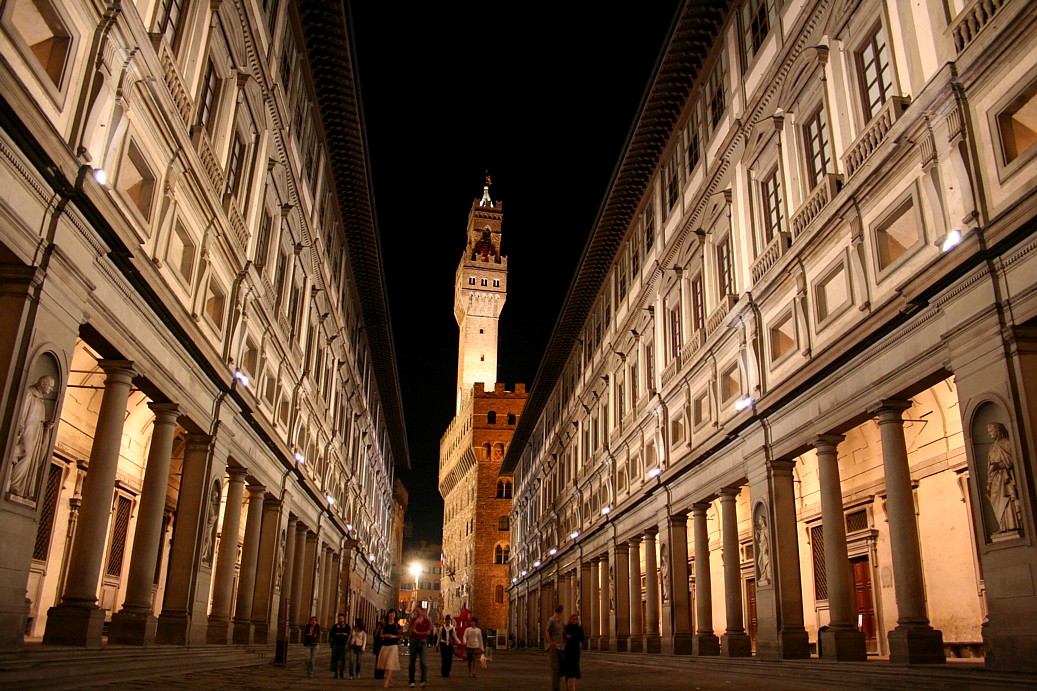
The Uffizi Gallery is located on the upper floor of the big building planned by Giorgio Vasari from 1560, which housed the administrative offices of the Tuscan State. The Gallery was created by Francesco I, and then enriched and enlarged by other members of the Medici family, who were great collectors of paintings, sculpture and arts in general. The collection was then rearranged and enlarged by the Lorraine Grand-dukes, who succeeded the Medici family, and finally by the Italian State.
The building also houses other relevant collections: the Contini Bonacossi Collection and the Collection of Prints and Drawings (Gabinetto Disegni e Stampe degli Uffizi).The Vasari Corridor, the raised passageway connecting the Uffizi with Pitti Palace, was also built by Giorgio Vasari in 1565: the Corridor is hung with an important collection of 17th-century paintings and the famous collection of self-portraits of artists.
Tickets: Full price 6,50 € Reduced 3,25 € Free admission for people under 18 or over 65, students and teachers of faculties of architecture, cultural heritage conservation, educational sciences, or of Fine Arts Academy, tour guides.
Opening hours: Open Tuesday to Sunday 8,15 – 18,50Closed Monday, New Year’s Day, May 1st and Christmas Day. For Booking: +39(055) 294883 Booking charge: 4 €
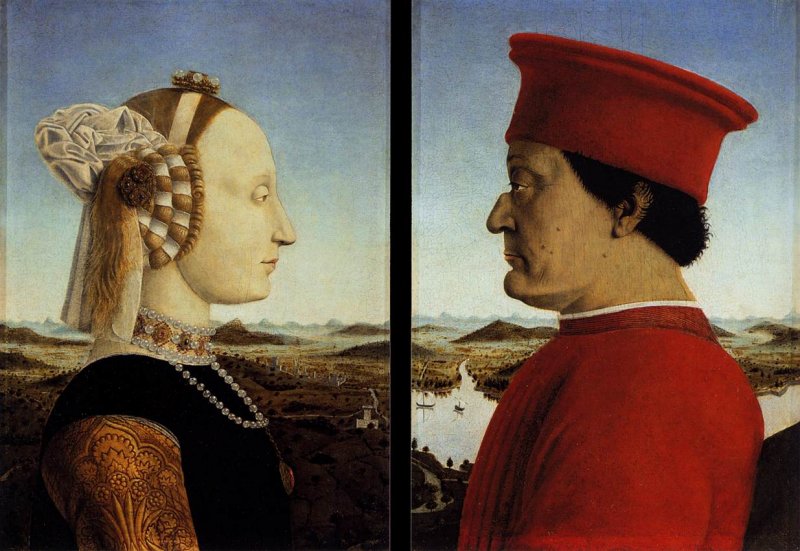
Double Portrait of Federico da Montefeltro and his wife, by Piero della Francesca
Self-Portrait, by Raphael
The Head of Medusa, by Caravaggio
The Birth of Venus, by Botticelli
Bacchus, by Caravaggio
Here are two nice videos that I found on Youtube which show the Uffizi tour :-)
Palazzo Strozzi has been built during a long time and various architects planned it: the result is an harmonic and perfect example of reinassance palace, the most regular, homogenous and symmetrical one, in a time which the symmetry and the regularity of shapes were very appreciated gifts. This palace was the house of the Strozzi family, an important dynasty of rich florentine bankers, who built this magnificent building to demonstrate its own wealth, to use it as personal residence, but also for its own transactions and businesses.
The private house is placed on the two superior plans, while on the ground floor, around the inner court, there were shops and banks: the court was opened the public and it was shaped like a real public city square, an extension in the private space of the public city.
Externally the Palace is solid and compact: a facade in solid stone, with a “bugnato” surface with large sketched blocks, with regular windows, diversified for level: square small and to the ground floor, double lancet windows closed in an arc to the superior floors. Even in the inner court, in the rooms and in the plant, we can see the perfect symmetry. The inner court is just so beautiful, it’s easy to imagine it full of people busy with business in their daily lives, walking in the rooms and stepping up the big elegant stairs.
Today Palazzo Strozzi is an important museum with international expositions of paintings sculptures, architecture, which periodically change. The Palace is in the historical centre of Florence, easily reachable by bus or with a 5 minutes walk from Santa Maria Novella Station.
Santa Maria Novella is one of the most celebrated churches of Florence, and probably it's also my favorite one. It had been built by the Dominican friars in the second half of 13th century in gothic style; it became quickly one of the main reference model for the italian gothic style. The church had been planned by some architects-friars in 1200 AD, while the facade instead was added during the renaissance, and had been designed by Leon Battista Alberti.
The church externally presents the typical aspect of medieval architecture of Florence: solid and simple, made with local yellow stone (pietra forte), a simple kind of stone, not refined. A lot would seem a confidential church, focused on the inside, but the three enormous decorated windows of the apse let the light shine, as beautiful as innovative considering the time of the ages and and height of the openings too.
The inside is a real masterpiece of gothic architecture: I mean the italian gothic, if you're looking for things like Notre Dame de Paris you could be disappointed, because that is french gothic which is quite different. Italian gothic was born before french one and has established canons and rules of the style; in France then the style has been reinterpretated in a very characteristic way. The gothic style of Santa Maria Novella is sober, strict and essential, ornaments are not elaborated sculptures and hazarous vaults, but it is adorned with the most simple and true qualities: geometry, the contrasting colors of the materials, an incredible constructive skill.
The plan is cross shaped, with three aisles and pointed arches. Arches are decorated with alternated green and white stones. The spans as they are approached all' apse reduces own width, increasing the perspective effect and giving the illusion that the aisles are longer than they really are. This testifies the huge skills of architects of 1200 AD: a careful study of the perspective, in an age in which it was still unknown. Over the altar has been recently replaced the famous wooden Christ by Brunelleschi, eventually restored. The ambient inside is wonderful in its simple perfection given from geometry, and is more lightful thanks to the three great windows of the apse.
The facade by Leon Battista Alberti represents the synthesis of all the ideals of beauty in renaissance: a modular, geometric facade, organized with geometric rules and proportions. The two lateral curls in the upper part of the facade are an addition stuck there in baroque age, try to imagine the facade without the curls and find the perfect proportions.
Santa Maria Novella is not only a church, is a complete monastic complex with a cemetary, a botanical garden, the refectory and various chiostri. Also these places are wonderful and decorated with spectacular frescoes and sure deserve a visit.
There is also an ancient herbalist shop runned by friars since 1500 AD, with lots of typical herbal products and wonderful ancient furniture and jars.
Here's a video guide that I found on youtube of the church of Santa Maria Novella, very useful for your tour!

 The Piazzale Michelangelo is surely one of the most beautiful places to visit in Florence Italy. Placed high on a green hillside overlooking the city, visitors can enjoy a breathtaking view of the whole city: you can spot the duomo, Palazzo Vecchio with its tower, Giotto’s bell-tower, the Arno river that flows and tear the city in two parts, with its bridges in sequence.
 Piazzale Michelangelo was built in 1869 and designed by architect Giuseppe Poggi, when Florence became the capital city of Italy (for a short period) and needed big, magnificent public spaces to represent the power of the newborn Reign of Italy.
 San Miniato al Monte
 the wedding of a japanese couple in San Miniato al Monte


 Between this year and 1421 the tribunes and probably the drum of the dome were built. The octagonal dome, consisting of two concentric






 The plan is cross shaped, with three aisles and pointed arches. Arches are decorated with alternated green and white stones. The spans as they are approached all' apse reduces own width, increasing the perspective effect and giving the illusion that the aisles are longer than they really are. This testifies the huge skills of architects of 1200 AD: a careful study of the perspective, in an age in which it was still unknown. Over the altar has been recently replaced the famous wooden Christ by Brunelleschi, eventually restored. The ambient inside is wonderful in its simple perfection given from geometry, and is more lightful thanks to the three great windows of the apse.


 Posts
Posts


