Ricerca personalizzata
Showing posts with label video. Show all posts

The Uffizi Gallery

Wednesday, December 31, 2008
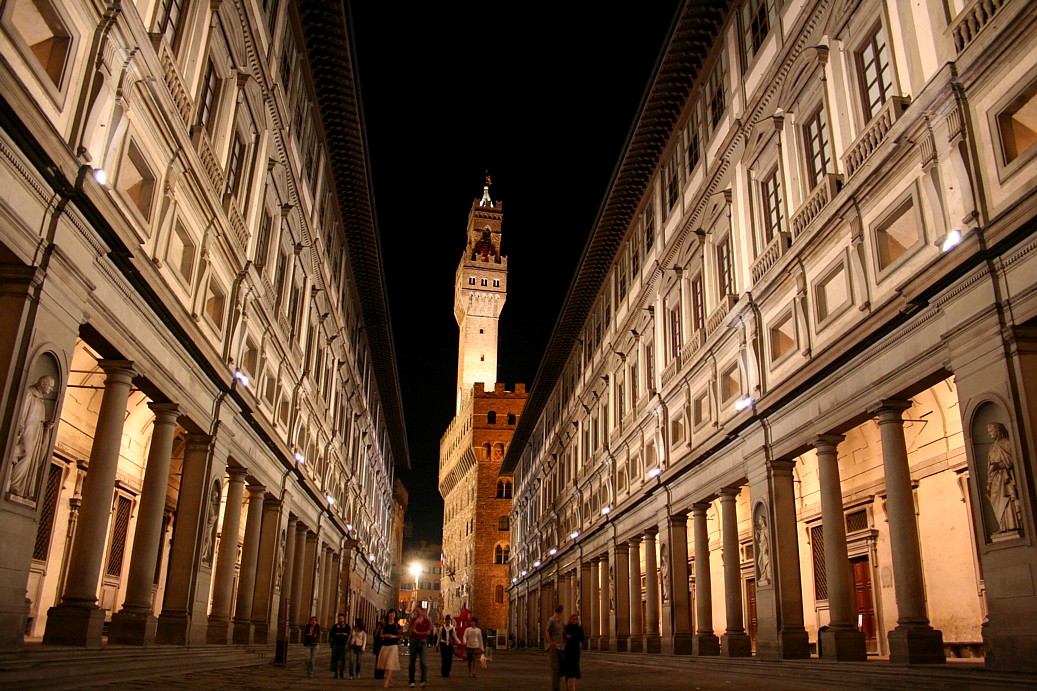

This is probably the most famous museum in the world. Its collection of Primitive and Renaissance paintings comprises several universally acclaimed masterpieces of all time, including works by Giotto, Simone Martini, Piero della Francesca, Fra Beato Angelico, Lippi, Botticelli, Mantegna, Correggio, Leonardo da Vinci, Raffaelo, Michelangelo and Caravaggio. The German, Dutch and Flemish masters are also present in the Uffizi museum with important paintings by Dürer, Rembrandt and Rubens.

The Uffizi Gallery is located on the upper floor of the big building planned by Giorgio Vasari from 1560, which housed the administrative offices of the Tuscan State. The Gallery was created by Francesco I, and then enriched and enlarged by other members of the Medici family, who were great collectors of paintings, sculpture and arts in general. The collection was then rearranged and enlarged by the Lorraine Grand-dukes, who succeeded the Medici family, and finally by the Italian State.

The building also houses other relevant collections: the Contini Bonacossi Collection and the Collection of Prints and Drawings (Gabinetto Disegni e Stampe degli Uffizi).The Vasari Corridor, the raised passageway connecting the Uffizi with Pitti Palace, was also built by Giorgio Vasari in 1565: the Corridor is hung with an important collection of 17th-century paintings and the famous collection of self-portraits of artists.

Tickets:
Full price 6,50 €
Reduced 3,25 €
Free admission for people under 18 or over 65, students and teachers of faculties of architecture, cultural heritage conservation, educational sciences, or of Fine Arts Academy, tour guides.

Opening hours:
Open Tuesday to Sunday 8,15 – 18,50Closed Monday, New Year’s Day, May 1st and Christmas Day.
For Booking: +39(055) 294883
Booking charge: 4 €
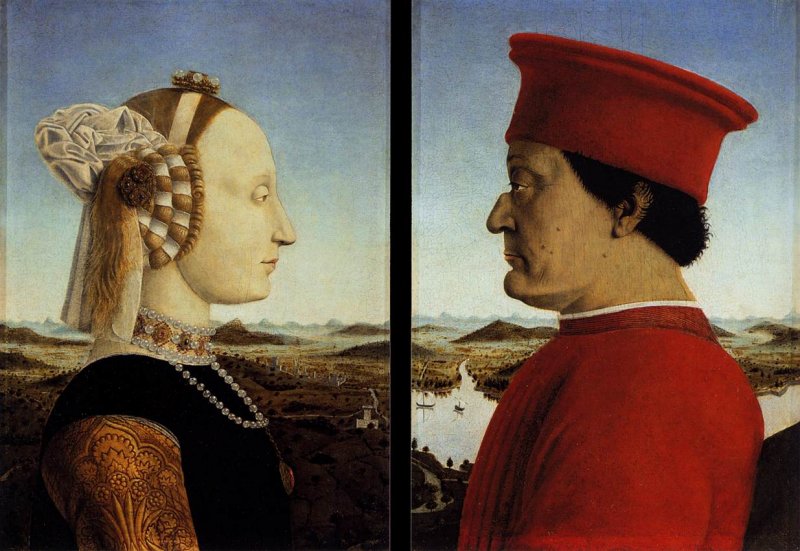
Double Portrait of Federico da Montefeltro and his wife, by Piero della Francesca
Self-Portrait, by Raphael

The Head of Medusa, by Caravaggio

The Birth of Venus, by Botticelli

Bacchus, by Caravaggio
Here are two nice videos that I found on Youtube which show the Uffizi tour :-)


Giardino Sonoro - Sound Garden

Tuesday, November 11, 2008


This little but precious garden is pretty unknown, but I strnogly recommend the visit for various reasons. First of all, because it is so beautiful; second: because entrance is free; third, because it is perfect to escape from city traffic and have a rest between plants, flowers, sculptures and sounds which stimulate your mind.
The Sound Garden of Florence (Giardino Sonoro) is located in the Limonaia dell' Imperialino, at the end of Viale dei Colli Imperiali, close to Porta Romana and Piazzale Michelangelo. You can reacht it by taking the bus 12 and get to Porta Romana, thenk walk a few meters. This is a green, elegant part of the city, but often overcrowded with cars. Just step into the Sound Garden and relax!

This is not just a simple garden like others, is a complete entity that covers art, sculpture, sound search and architecture. The sound garden is an idea of Lorenzo Bruzzi, sound designer, and Stefano Passerotti, environmental designer. They took advantage also of other collaborators from various fields. That one of the Limonaia dell' Imperialino has been the first Sound Garden, and is permanent, but this team has realized several sound gardens in various cities of the world, like New York or Zurigo. When I visited the gard for the first time the installations were different from the actual ones, this means the garden changes, is periodically renewed and updated.

Visit the garden by foot, with no hurry, and hush! You put your clock away, turn off your cell phone and listen to all the rest! Entering, on the left there is a small building that is the limonaia, here you'll get a sheet which describes and localizes the installations, including the names the authors. Inside the limonaia you can find also a flyers and informative material on the team of the sound garden and their activities. The path is marked from a wooden footbridge that creaks under your steps, a squeeky clear sound that marks the space. Between plants and flowers there are several objects: sculptures, pots, stones… watch them and listen to them, 'cause they speak and they tell sounds and feelings that are only waiting for being recognized. Some elements are absolutely simple and primordial, like stones, others are solid and familiar, as terracotta, others are modern and technological. The sounds you can liston to are of various types: grinding, annoying, harmonious, musical sounds, breaths… and are not only those reproduced by the sculptures, there is also the wind between leaves to listen!

The path through the sound garden let you get shakes of every type: for your eyes, ears nose, and sure for your mind. You'll feel relaxed and recharged after the visit, not only rested but also full of ideas! This is one of my favorite Florence secret corners, recommented to those who loved the historical center of Florence but wants to experience something of new and avantgarde; it will be surely apprciated by lovers of art, environmental design, gardening and sound search. Sure is very suitable for children too… the sound garden is a lot stimulating for kids, with all those sounds, those colors, those strange objects…

The evening show is more evocative because it's enriched with spectacular artistic lightening system, that it interacts with shapes and sounds.
The Sound Garden is open every day from 10,00 to 22,30 and entrance is free.


Here is a very special video taken from Youtube that shows the Sound Garden, and sure gives you the atmosphere!

Market of San Lorenzo

Monday, November 10, 2008

Every tourist visiting Florence has to take a tour of San Lorenzo market, the big and famous market whitch sells just everything, clothing, accessories, souvenirs of Florence, but above all they are specialized in artigianal leather products: coats, handbags, purses, belts, gloves, etc. Take a tour of the external stalls, then penetrate in the covered market!


The market of San Lorenzo is very close to the dome and train station, right in the center of the city, it is just impossible impossible not to find it. The building, built between 1870 and 1874 is one of first in Italy to being realized with modern techniques (for the age…), materials are iron, glass and cast iron, and it has been planned from Mengoni, who designed also the other market of Florence (sant' Ambrogio, a smaller one but also pretty and much less chaotic) and the gallery Vittorio Emanuele II of Milan. The base of the buildinf is monumental, made in stone, very suited to the Florence context, with large round arches; the upper part is light and transparent thanks to the glass a decorated with a metallic structure. The big glasses make the inside of the covered market very lightful.


Externally the market is surrounded with loggiati of classical arches, that turn around along the roads surruonding the building; in these roads you'll find all the external stalls.
The walk among the stalls is usally pretty stressful, the road is often overcrowded, and sometimes covering just 300 meters can take a long time… the stalls are selling just everything, mostly cheap leather accessories, but also t-shirts, souvenirs of Florence (some of them are really kitsch and funny!), clothes... there are also some vintage clothing and some craftsman's shops.
But what I most like of San Lorenzo are the benches of the food market, those situated in the inside. There are butcher's shop benches with wonderful pieces of fresh meat (Tuscay and Florence are well known for it's fine quality meat). Not to mention the benches of the cheeses… Some benches sell jars of the best conserves, like peppers, dried tomatoes, etc... others sell dried beans and cereals in bug raw cotton bags which are so beautiful to see… I love the scents of San Lorenzo, the smell of the fresh blood of the meat (it's a bit creepy but i like it!), the scent of seasoned pecorino cheese and the tasty smell of spices…


I suggest you to visit the market in the early morning, it' less crowded and all the shops are open (food shops are cloesed after 14.oo pm). If you're hungry taste the tipical Florence fast food: bread with "lampredotto" at Nerbone's (inside the market), hot boiled tripe and other offals served in a piece of bread and red wine.


Here are two videos taken from Youtube of the market of San Lorenzo, enjoy!


Santa Maria Novella

Santa Maria Novella is one of the most celebrated churches of Florence, and probably it's also my favorite one. It had been built by the Dominican friars in the second half of 13th century in gothic style; it became quickly one of the main reference model for the italian gothic style. The church had been planned by some architects-friars in 1200 AD, while the facade instead was added during the renaissance, and had been designed by Leon Battista Alberti.

The church externally presents the typical aspect of medieval architecture of Florence: solid and simple, made with local yellow stone (pietra forte), a simple kind of stone, not refined. A lot would seem a confidential church, focused on the inside, but the three enormous decorated windows of the apse let the light shine, as beautiful as innovative considering the time of the ages and and height of the openings too.

The inside is a real masterpiece of gothic architecture: I mean the italian gothic, if you're looking for things like Notre Dame de Paris you could be disappointed, because that is french gothic which is quite different. Italian gothic was born before french one and has established canons and rules of the style; in France then the style has been reinterpretated in a very characteristic way. The gothic style of Santa Maria Novella is sober, strict and essential, ornaments are not elaborated sculptures and hazarous vaults, but it is adorned with the most simple and true qualities: geometry, the contrasting colors of the materials, an incredible constructive skill.


The plan is cross shaped, with three aisles and pointed arches. Arches are decorated with alternated green and white stones. The spans as they are approached all' apse reduces own width, increasing the perspective effect and giving the illusion that the aisles are longer than they really are. This testifies the huge skills of architects of 1200 AD: a careful study of the perspective, in an age in which it was still unknown. Over the altar has been recently replaced the famous wooden Christ by Brunelleschi, eventually restored. The ambient inside is wonderful in its simple perfection given from geometry, and is more lightful thanks to the three great windows of the apse.
The facade by Leon Battista Alberti represents the synthesis of all the ideals of beauty in renaissance: a modular, geometric facade, organized with geometric rules and proportions. The two lateral curls in the upper part of the facade are an addition stuck there in baroque age, try to imagine the facade without the curls and find the perfect proportions.

Santa Maria Novella is not only a church, is a complete monastic complex with a cemetary, a botanical garden, the refectory and various chiostri. Also these places are wonderful and decorated with spectacular frescoes and sure deserve a visit.

There is also an ancient herbalist shop runned by friars since 1500 AD, with lots of typical herbal products and wonderful ancient furniture and jars.


Here's a video guide that I found on youtube of the church of Santa Maria Novella, very useful for your tour!